.jpg)
Design for complex societal challenges
The master's course "Design for Very Complex Systems" provides students with training in handling and solving complex societal challenges with the design discipline of system-oriented design.
- System-Oriented Design (SOD) is about understanding the system as a whole, not just as individual components. The designer identifies actors, processes, and relationships in the system. The goal is to create solutions that are robust and adaptable.
- Uses giga-maps (gigamapping) to visualize and tell what the challenges consist of, and points out possible solutions. Used as a starting point for conversations about how we can create positive social change.
Contact the educators: Professor Jonathan Romm and Assistant Professor Abel Crawford, Institute of design at AHO.
DESIGN: The Oslo Fjord is in a real crisis. The condition is deteriorating day by day for life and the environment both above and below the water's surface. Unfortunately, there is no single cause of the problems that can be easily fixed.
Something must be done to ensure that we and future generations continue to enjoy the Oslo Fjord. What needs to be done is not as obvious.
"We talk too little about how complex the problems around the Oslo Fjord actually are. It is really difficult to capture the total load on the fjord both in news stories and professional articles. Then we often end up blaming individual influences," declares Saskia Trubbach, researcher at the Norwegian Institute for Water Research (NIVA).
For seven intense weeks, she has collaborated with students and teachers at the Oslo School of Architecture and Design (AHO) and social entrepreneurs in the organization Pådriv on the student project "Our Fjord, Our Future?".
The superpower of designers
The project is part of the interdisciplinary master's course "Design for Very Complex Systems" which is taught to students across the disciplines of design, architecture and landscape architecture at AHO.
"We work with real cases in collaboration with people who really care about the societal challenges we tackle. This is not just a theoretical exercise," says Assistant Professor Abel Crawford at the Department of Design at AHO.
Precisely because the challenges associated with the Oslo Fjord and the surrounding water systems are characterized by a high degree of complexity, it is an ideal case for trying out the designers' toolbox, says Professor Jonathan Romm, who is responsible for the course.
Because it is precisely in the face of the really complex tangles that the design discipline of system-oriented design (see fact box) comes into its own.
"What can designers contribute when the future of the Oslo Fjord is at stake?"
"The designer's superpower lies in the ability to see the tasks and challenges from several different perspectives," answer Crawford and Romm.
This superpower requires access to and dialogue with experts and actors involved who can help shed light on the larger puzzle.
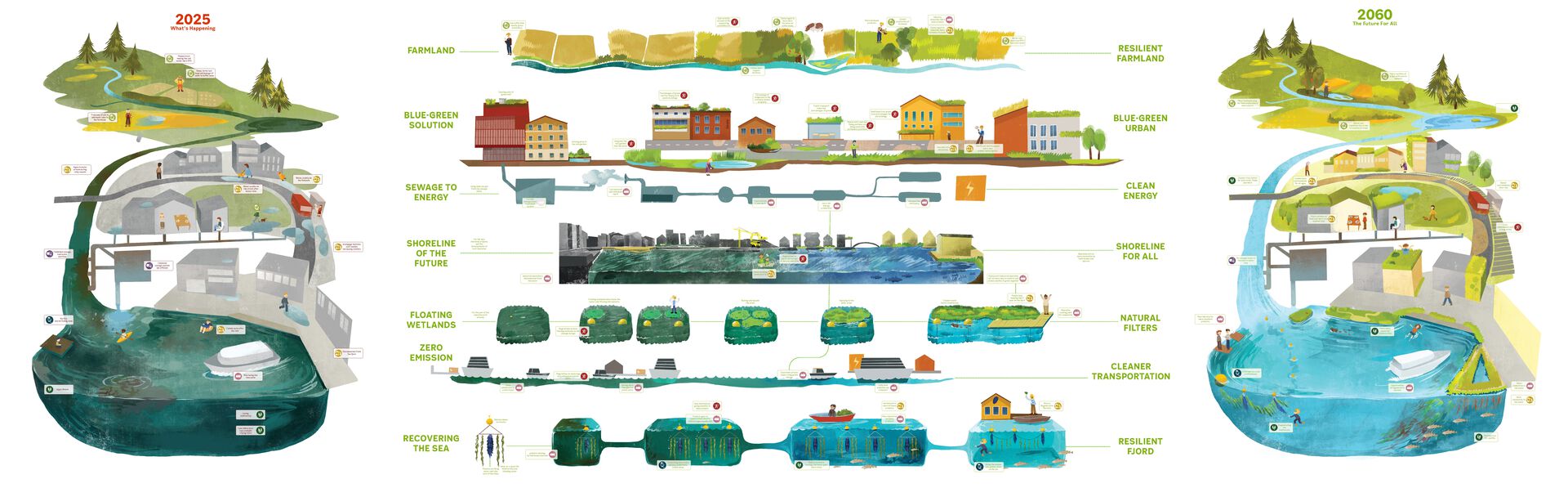
Collaborate to access expertise
Prior to the course, AHO's teachers have entered into a teaching collaboration with the Norwegian Institute for Water Research (NIVA) and the organization Pådriv, which makes its researchers and experts available to the students. Pådriv leads the project "Our Fjord", which is a unifying and coordinating work for everyone who wants to help make a real difference for the Oslo Fjord.
"Collaboration is critically important to gain access to experts who are motivated to get involved in the project. We have mobilised our network to arrange meetings with various actors who can share their knowledge, expertise and experiences," says Abel Crawford.
The master's course is carried out as a combination of classroom teaching, field studies and ongoing work in a rich design space.
"This will be a tangible project. We want to find the root causes of the problems. We want to take the problems into account, seek out the sources of the problems and literally see where the contamination of the water is coming from," Crawford continues.
A key aspect of seeking out problem sources was to consider the Oslo fjord as part of the entire watershed, which covers 118 municipalities. If one is to clean up the fjord, first we must stop the pollution coming into the fjord. That requires getting the students to investigate upstream, stopping contamination at its source, rather than jumping on treating the symptoms in the Fjord.
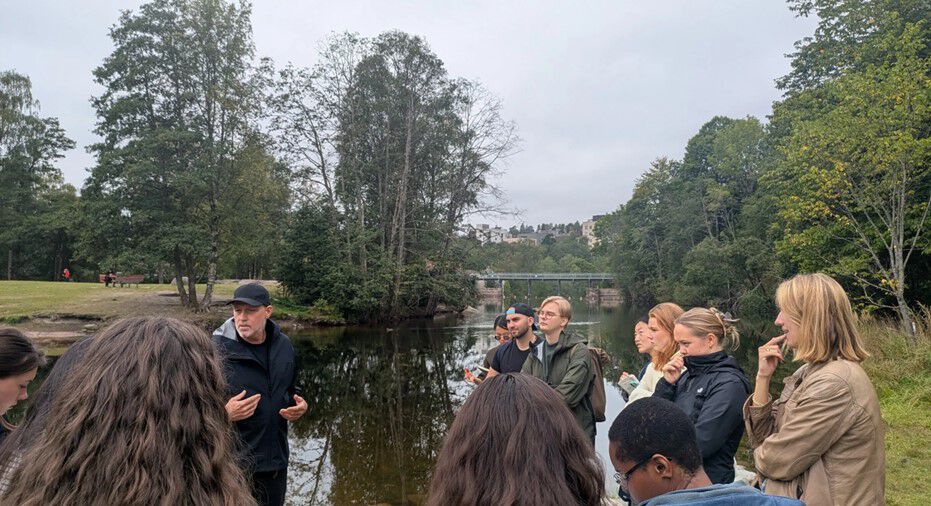
Field studies around the Oslo Fjord watershed
Students looked at representative sections of the Oslo Fjord Watershed, from urban and agricultural waterways flowing into Oslo Fjord, to spending time in the midst of the Oslofjord on Gressholmen, to a water purification plant, to the roof of the cultural center in Vega to look at water management.
Not only that, while visting representive sites, students met a range of stakeholders in addition to the partners. They met us during the field trips, including people such as municipal workers tasked with reducing stormwater inflows into sewer pipes, and hearing farmer plans to restore a natural waterway to reduce sediment runoff from their farm into the fjord.
"It was an interesting way to learn," comments Bloem Brouwers, one of the master's students who has carried out the student project.
"I really appreciated the various excursions where the students (and we) got out of the classroom. It is something completely different to read about a border zone or a drainage system under the ground, than to actually stand by a piece of erosion-prone soil while it rains heavily and soil particles are washed into the watercourse," comments researcher Saskia Trubbach.
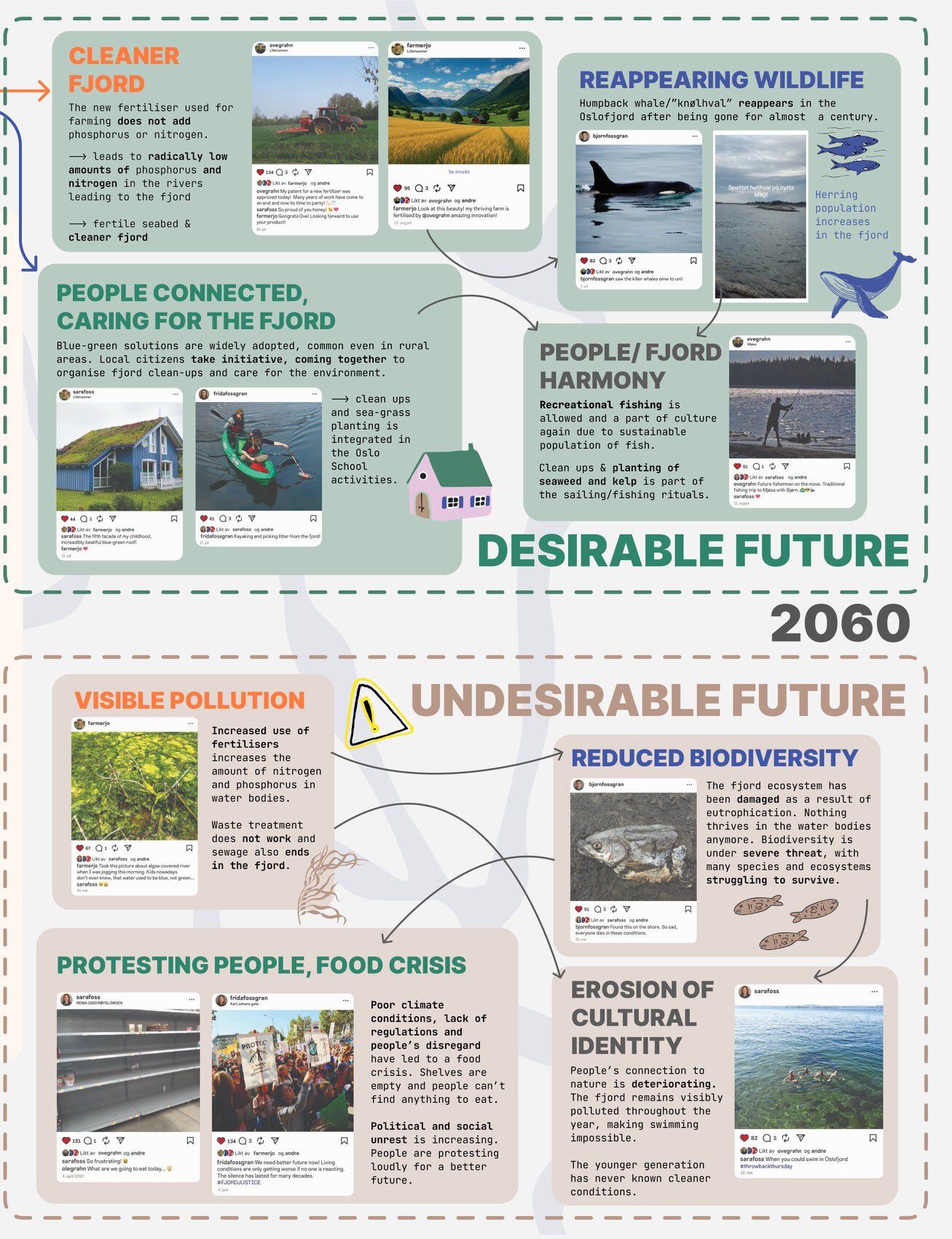
Drawing scenarios for the Oslo Fjord in 2060
Through the course, students gain experience in working with system-oriented design, which is a way to quickly learn a lot about an area. It is about developing compelling visual narratives that make it possible to create recognition, understanding and dialogue between experts and non-experts.
If the stories are to be credible, designers must engage and involve external actors in creating them. By talking to external actors from different points of view, it is possible to take several perspectives into account.
During the course, the students have presented their preliminary results to researchers and experts in NIVA and Pådriv, and further developed the stories based on the feedback.
Throughout the course, the master's students have used gigamapping, which is a design method to visualize and understand what the problems really consist of, who the actors are, the relationships between them and the complexity of the system. The point of Gigamapping is to facilitate conversations to better inform stakeholders and decision makers on where and how to intervene to improve the system.
The student groups have developed future images for the Oslo Fjord in 2060 where they show both a desirable future and one we do not want (if we do not do something).
The students also come up with concrete proposals for what we need to do by 2030 to improve water quality and ensure that we have a viable fjord in 2060.
The results of the project were shown at an exhibition in the premises of SoCentral in Sentralen in Oslo.
"The work that the students have done points precisely to the big connections. They clearly show that the challenges are complex, and cannot be solved by one sector or actor alone," says community planner and project developer Anna Linstad at partner Pådriv.
Impressed by the students
"I am incredibly impressed by what the students achieved in such a short time, and how much progress there was between the different sessions," says NIVA researcher Saskia Trubbach.
Many of the students came from abroad and did not know about the Oslo Fjord at all.
"So to understand such a complex issue, and capture the nuances of how different actors act is really impressive," she continues.
Trubbach says that they have hung up the student's posters in the office at NIVA, and received lots of positive and curious feedback from colleagues and visitors.
"They manage to create an end product that is both visually engaging and that embraces the entire breadth of the theme. It shows how much value design skills can have," says Trubbach, who himself has learned something new through the collaboration.
"We have learned new methods of arranging discussions and presenting results. The students came up with results that evoke many new thoughts about what we ourselves work with.
"The students have created maps that can work well as a conversation tool and a starting point for discussion in our further work. We look forward to diving further into the material and exploring some of the concrete solutions proposed by the students," says Anna Linstad in Pådriv.
Professional discussion partner
"It felt a bit daunting to have to present proposals for solutions to an audience that knows so much in the field," admits master's student Pernille Nilson Ramstad.
"It was fantastic to see that over the course of seven weeks, we were actually taken seriously as professional discussion partners," she continues.
"It's really motivating to get such good feedback from people who work in the field," adds fellow student Nikolai Yago Conde.
"This was a great topic that opens up new opportunities," says fellow student Esther Sigauke.