
Supervisor:
Miguel Hernandez Quintanilla
Moving beyond purely physical interventions, it proposes that the design of a more inclusive park lies as much in how it is organised and cared for as in how it is built — and that engaging elderly residents in the stewardship of a city park can generate benefits that extend far beyond the elderly themselves, enriching the life of the entire community.
Hamar is considered the urban centre of Norway's inland region — an area facing one of the highest proportions of ageing population in the country. Increasingly, elderly residents are relocating from houses with private gardens, tended over decades, into apartments and care facilities in the city centre. Faced with challenges such as reduced mobility, their world can narrow to what is immediately accessible in their local environment. This project takes the design of a more age-friendly city — using Hamar's oldest park as a case study — as a vehicle for rethinking how the design and management of urban nature can provide better quality of life not just for the elderly, but for everyone.
Hamar Park was founded in the late nineteenth century and became a principal recreational space for the city. For decades, it was maintained by a dedicated private association that organised events and cared for its grounds. In the mid-twentieth century the association dissolved, and the municipality assumed responsibility for the park's upkeep. Constrained by limited public funding, the park entered a prolonged process of degradation and neglect.
This project proposes two interconnected responses, the first is organisational
Rather than directing public funds solely towards contracted maintenance, the municipality would redirect a portion of that budget toward a team of facilitators responsible for coordinating the collective stewardship of the park. This model engages not only elderly residents, but also local schools and volunteer associations, transforming the park into a multigenerational project. The facilitator would establish an annual calendar of activities, connecting volunteers of all ages. The primary goal of this model is to ensure that elderly remain active, engaged, and valued members of society. Participating provides enjoyment, a sense of achievement, and opportunities for social interaction. At the same time, the park benefits from improved maintenance, creating a greater sense of safety, ownership, and community while supporting inclusive design and increasing biodiversity.


The second response is spatial
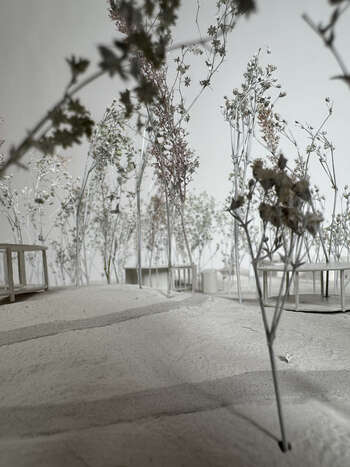
The park is made fully accessible while providing the infrastructure necessary for everyone to contribute to its upkeep. The park becomes a place for everyone, while being specifically designed to enable elderly to contribute according to their abilities. A new network of gently sloping pathways allows access to all areas of the park to users of all abilities, ensuring that access to the quieter, more intimate corners of the landscape is not a privilege reserved for the most mobile. At the top of the hill, a new viewpoint with seating provides a destination and a gathering point. A new pavilion becomes a venue for concerts and events. A community house serves as both the organizational and social heart of the park.
.jpg)


A series of physical interventions is introduced
The interventions are typologies that can be located at different points in the park: elements that address accessibility and maintenance as one and the same. Raised planting beds, that allow watering and trimming without strain, are positioned along pathways throughout the park. At various locations in the park, raised watering stations enable people to fill watering cans without bending down, making it possible for more people to take part in the upkeep. Tool sheds located along the pathways are used to store maintenance equipment that can be used by the volunteers. Handrails along the paths provide support and make it easier for a wider range of users to move comfortably through the park, while the integrated benches offer opportunities for rest. Age-friendly benches are distributed throughout the park.


Taken together, these organizational and physical interventions form a model for age-friendly urban nature. The project demonstrates that designing with the needs of elderly as a starting point can create better public spaces for everyone. Limited municipal budgets and an aging population do not need to be viewed as problems. As this project illustrates, they can instead become opportunities for elderly to contribute to their communities on their own terms. The model presented in this project could be adapted and applied to varying degrees, in parks and green spaces across other municipalities in Norway. In this way, urban parks and recreational spaces can become platforms for community, connection, and learning across generations.


Contact

Eline Mogen