
Supervisor:
Sabine Müller
Giambattista Zaccariotto
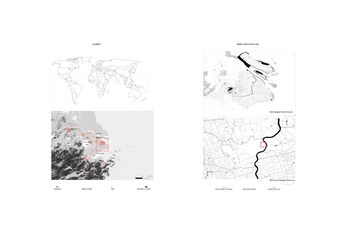
Situated within the city’s central urban district, the site faces three critical challenges:
- Urban Flooding due to inadequate drainage systems,
- Land Subsidence caused by groundwater over-extraction, and
- Low-quality Urban Space resulting from high-density development and fragmented green networks.
The project aims to:
- Enhance urban resilience against climate risks,
- Recharge groundwater through stormwater infiltration,
- Improve microclimatic conditions,
- Revitalize public green spaces,
- Recover historical memories embedded in the area’s lost waterway systems.
Design process:
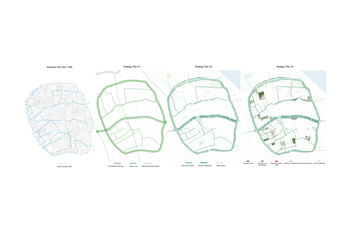
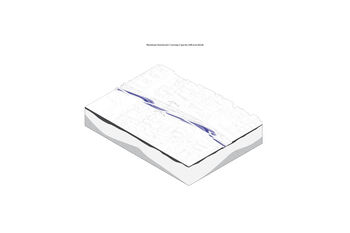
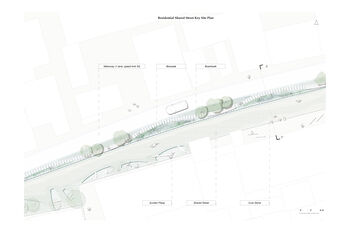
- Recovery of Historic Water Veins: Three typologies of historical waterways—city-scale canals, town-scale moat, and street-scale rivulets—are reactivated through hydrological analysis and historical mapping. This intervention addresses goals 1 (resilience) and 5 (cultural memory), visualized through a strategy plan and three typical sections demonstrating integration with existing urban fabric and the respond to the past.
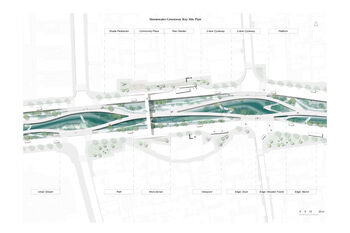
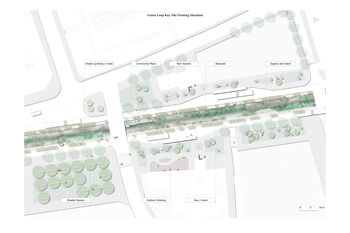
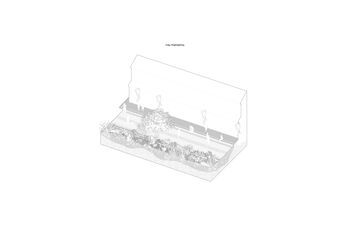
- Landscape Regeneration: Three key sites along the revived corridors undergo ecological retrofitting, featuring permeable surfaces, bioswales, and community plazas. Zoom-in plans illustrate how these spaces reconnect fragmented neighborhoods while creating multifunctional green infrastructure (Goal 3 and 4).
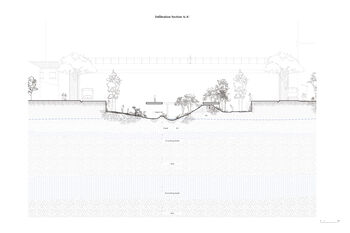
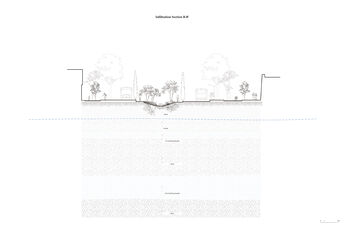
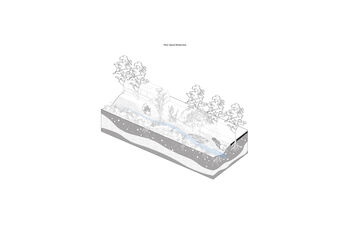
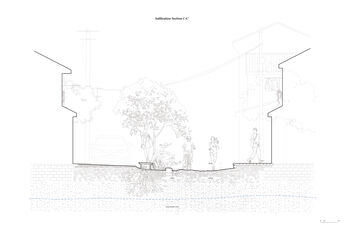
- Subsurface Infiltration: A layered strategy combining permeable pavements, infiltration material, and retention cells is proposed to mitigate land subsidence (Goal 2), detailed through sections showing soil stratification.
Future Vision:
- At the local scale, increasing stormwater retention capacity and creating interconnected blue-green networks.
- At the metropolitan scale, establishing a model with climate adaptation, while reconnecting citizens to the area’s aquatic heritage (the Water Veins).


Contact
Shijia Han / hanshijia123@outlook.com