
Supervisor: Hilde Angelfoss
The diploma started out with flood safety, as the summer of 2025 was riddled with devastating floods that destroyed homes and lives in both North America, Europe, and Southeast Asia. As the project evolved, it became clear that the product was not limited to a flood scenario only, but for all scenarios where the user would have to evacuate. The diploma focus is hence personal evacuation preparedness, and how to make the interaction with the user and product as optimal as possible to enable quick evacuation.
Insight
The main points from the research are that the more prepared and self-sufficient the individual is, the easier it will be for all parties. Preparation is also highly important because people, when planning for evacuation, will become more aware of the needed behaviour and steps required to stay safe. This will increase the probability for rational behaviour and rapid response when needed.

The box
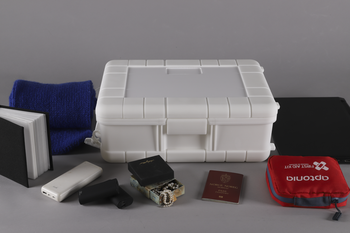
The result of this diploma became a box that is a tool to help evacuation moments go more easily, enhancing individual safety and the protection of critical belongings. With a combination of easy storage and preparation, the threshold for leaving your home will be smaller and quicker, and you will be able to keep what’s precious to you even though things around you are falling apart.
The first thing the user will do is the planning: Writing down what they want to bring and where they keep those items they don’t want to keep in the box full-time, and packing the items that they want to keep in the box on a regular basis. This will ensure that these minimum required items are gathered and ready to leave. Making the list easy to see when opening the box will help the user get a quick overview of what’s already in the box, and the location of potential other items that are spread around the home, enabling them to quickly decide what other items to bring and get them.

From the insight, I also found that many don’t want to keep all their valuable items in one place in case of theft. Therefore, the items that you don’t use every day, like papers and photos, are to be stored in the box at all times, while items like jewellery and a laptop will be where you use them normally. This is where the pre-planning comes in. With a written list of what you want to bring and where you keep them already prepared, it will take less thought and concentration to get them in a hurry. The same goes for medicines, but, if possible, there is the option to keep the extra medicine in the box at all times.

Why choose this box instead of a bag or a suitcase you already have? This question popped up throughout the project, and the answer lies in the design and intended process of user preparation.
The design is optimised for the intended use, from the user interaction, size, material, to the protection it gives the items inside the box. If you were to use a backpack or suitcase you already have, these will have an unpredictable material or size. You will also lose the preparation aspect of this product. By taking active steps to prepare and acquire the box, you will more easily take the danger more seriously and mentally prepare for an evacuation situation.




Contact

Ingvild Telnes / Ingvild@seawater.no