
Supervisor:
Beate Hølmebakk, Chris-Johan Engh, Per Olaf Fjeld, Luis Callejas
Pregnancy, childbirth along with the transition to motherhood can evoke a wide range of emotions, from joy and excitement to fear and anxiety. It is estimated that one in five mothers worldwide will experience postpartum mental health issues. Yet seventy percent of them will either downplay or hide what they are experiencing due to fear, guilt, and shame, which can lead to serious and sometimes tragic outcomes.
This diploma is a speculative architectural proposal for a mother and baby unit. Rooted in the notion that the witches are never alone x the women are never alone, the diploma seeks to create a space where mental vulnerability is acknowledged rather than concealed, and where privacy and intimacy can coexist along with community and professional care.
Rather than focusing solely on the relationship between mother and baby, the project emphasizes the importance of community among women navigating in the transition into motherhood. Their power is tied up to a sisterhood, bound to the gathering of mothers who share their pain and their love, supporting each other while being supported.

A house for witches - a postpartum mental health center has a total length of 190 meter and consists of six houses, all connected to one unit by two long corridors forming its long shape. A shape designed from the architectural interpretation of the corridor as a path toward recovery.
The first corridor connects the houses of the day, the second leads to the house for sleeping, belonging to the night, both leading to the tower in the middle that acts as a binding threshold between day and night, anchoring the entire composition.
House for sleeping x the corridor
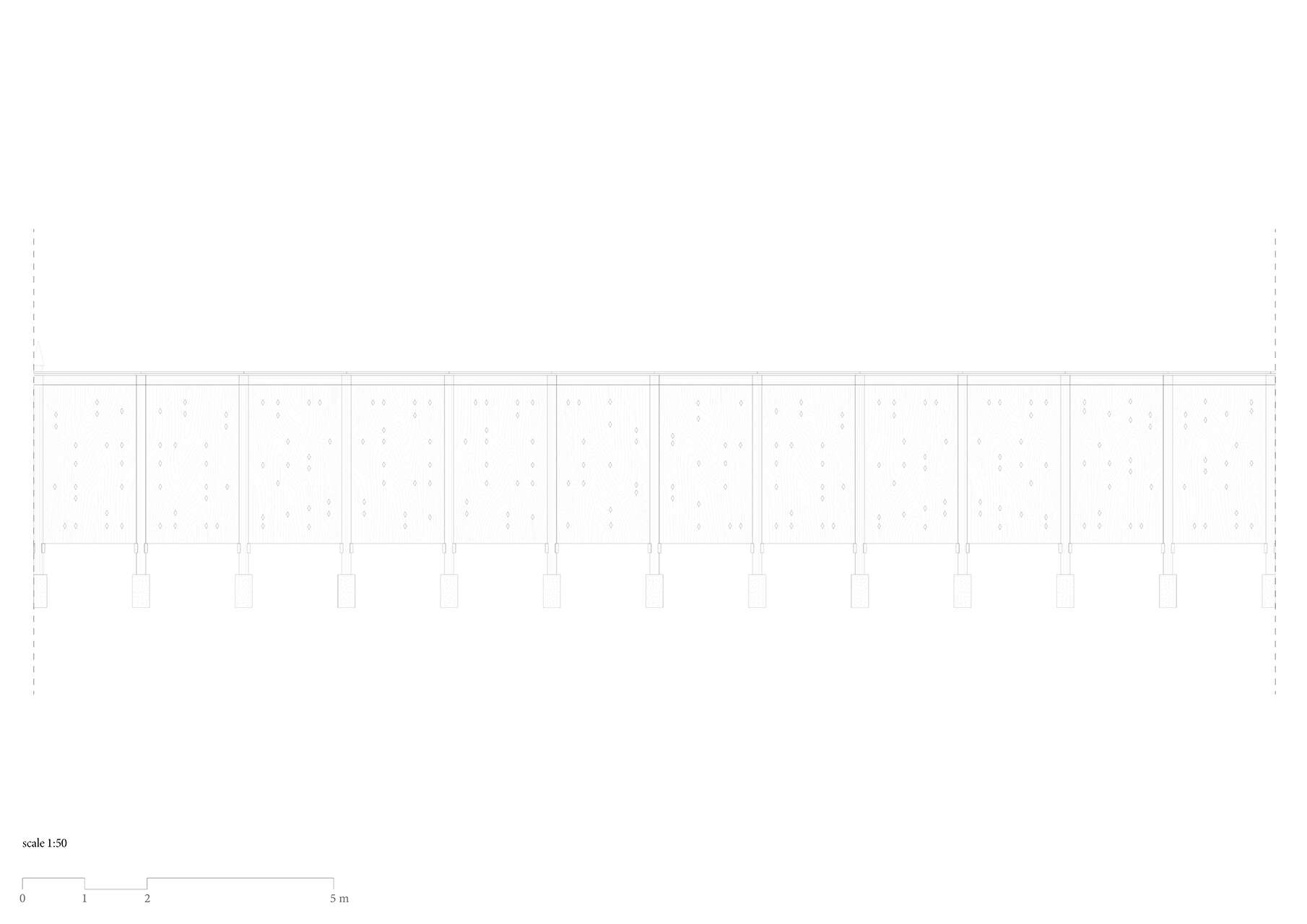
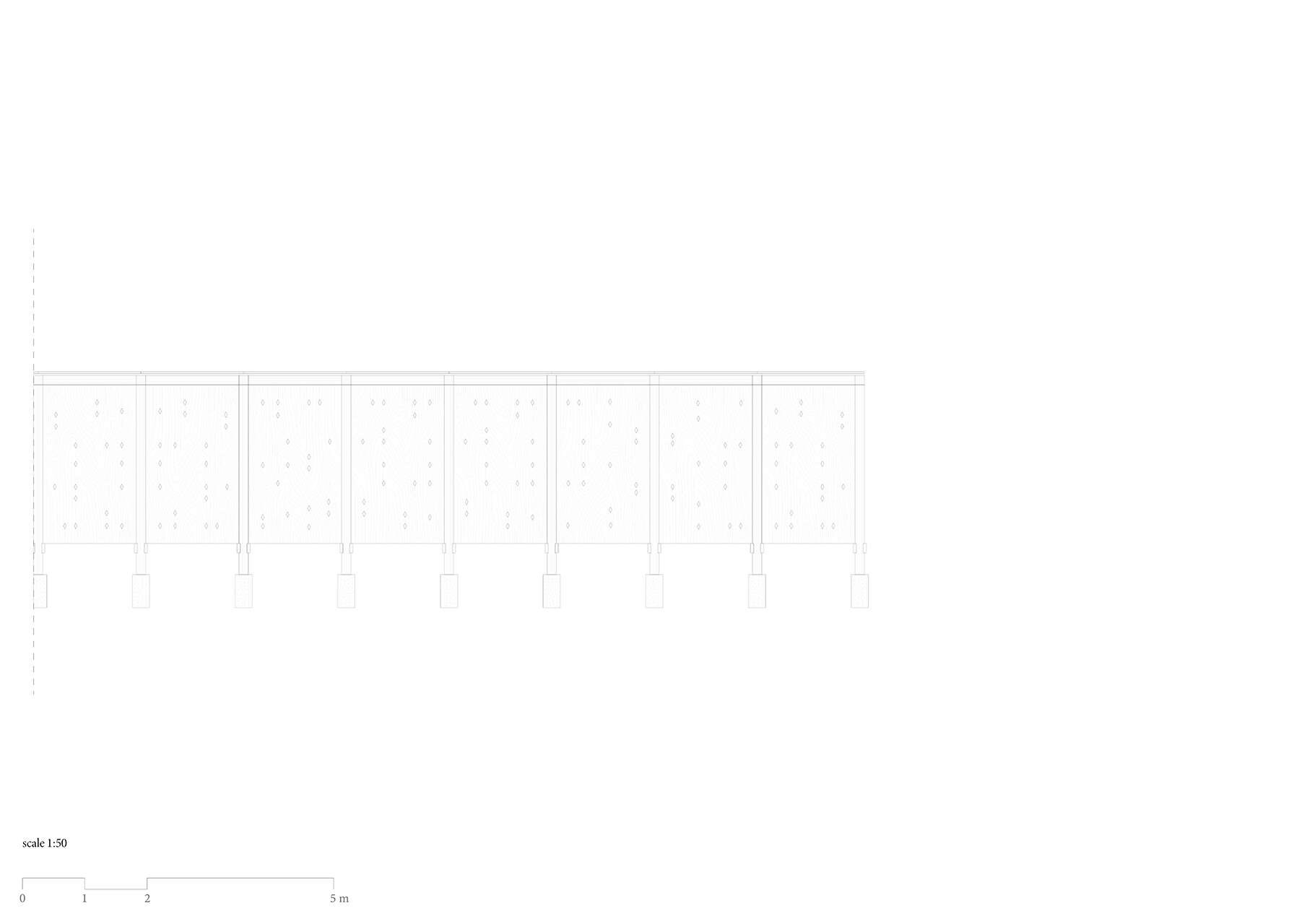
Beginning from the end of a house of witches – a postpartum mental health center is house for sleeping with a spatial program consisting of six bedrooms with bathrooms and a shared laundry room.
House for sleeping is placed in the deepest and darkest part of the forest, within a protected interior where silence becomes possible. Here, the mothers can gather in stillness and seclusion. They can whisper, scream, grieve, and rage. Yet, house for sleeping is also a space where the mothers can slip away and rest in their own little house, still being among each other through a connected architecture. They will meet in the passing, in their dreams, in the gravity of sleeplessness.
The corridor is exaggerated in its length, a stretched, almost endless passage immersed in darkness, interrupted only by the light from the moon or the sun filtering through rune-shaped openings along one of the sides. It is both a space and a condition. The mothers will move in the narrow, immersive darkness, passing each other, whisper to each other. Breaths, half-sentences, recognitions. In the howling sound of the wind, in the fragile wooden construction, elevated from the ground. This is where the witches walk, and where the mothers return, again and again, until the darkness becomes familiar enough to inhabit, and the silence begins to speak.






Observation tower
Moving from house for sleeping, through the corridor, the mothers enter the first floor of observation tower, a tower intended for the midwives.
In a house for witches – a postpartum mental health center, the witches are not only the mothers, but also the midwives who care for them and their babies, guiding them through the fragile transition into motherhood. The midwives become part of the sisterhood itself. They are not distant clinical figures, but are present within the architecture, inhabiting it alongside the mothers. They move through the house as caretakers, witnesses, and protectors - women who hold space for vulnerability without judgement. They observe, but they do not control.
The first floor of observation tower acts as a connecting threshold, linking the two corridors. From here, the mothers can either pass through, take the elevator to the second or third floor, or, in the case of the midwives, use the spiral staircase to reach their private spaces within the tower.
The first two floors are the only levels of observation tower accessible to the mothers. The first floor contains a sleeping space for the babies and a bedroom for a midwife, who protects and cares for them during the night. The second floor is a nursery room where the mothers can breastfeed and bond with their babies while being gently guided by a midwife. Both spaces are placed at the centre of a house of witches - a postpartum mental health center, reflecting how the babies become the core around which everything gathers.
The fourth floor marks the first level accessible only to the midwives. It contains two bedrooms for the midwives working night shifts.
The fifth floor is the changing room for the midwives to get dressed for the day or undressed for the night.
The sixth floor contains the kitchen, a place where the midwives gather, to pass information, to share their observations.
The seventh and eighth floors contain the administrative offices, where the midwives carry out their paperwork. From here, the structures of care are maintained and kept in place.
The top floor is the observation post.


Common house
With community and sisterhood as central themes in the architectural program, a house for witches - a postpartum mental health center explores how spatial transitions and boundaries can frame an environment in which healing is not isolated, but social, and where architecture becomes an active tool for strengthening the relationship between the mothers, as well as the relationship between mother and baby.
Common house has a spatial program consisting of a shared kitchen, an eating area, a sleeping area for the babies along with a nursery area, a living room, a library and an herb garden at the center of the circular building, with all the spaces oriented towards it, embracing the greenery. Here the mothers will cook for each other. Sharing meals, reading books, talk to each other, whisper to each other, care for the herb garden.
Common house is private, yet its privacy exists among the mothers, among the midwives, among the witches. Within the transparency of motherhood and mental illness, the mothers will turn their pain outward, transforming their isolation into a collective power helping them in their recovery.


House of weaving
Historically, weaving is one of the most significant and enduring crafts associated with the stories of witches. Handcraft and witchcraft have always been intertwined, and through the act, the mothers, the midwives, the witches, will meet and share their knowledge and their stories.
Weaving is a slow and careful process that usually demands collaboration, making it both a communal and social act, one that depends on cooperation, trust, and the exchange of skills. Within the act, women bond through teaching and learning, creating a foundation for conversation and mutual support. Weaving becomes not only a method of making but a methodology of connecting. It is a shared task that ties the witches together through their collective effort while providing the mothers with a sense of belonging, of being useful and indispensable.
With house of weaving, the aim is to create a space for the mothers that focuses on the presence, the practical, and the creative rather than on the vulnerable themes tied to their illness or to motherhood.
House of weaving consists of a loom area, a toilet, and a storage room. Sliding doors on the sides of the house to create as much daylight as possible, opening the space to let nature in.


House for a therapist x house for a doctor
In addition to a house of witches - a postpartum mental health center being grounded in collective healing, the importance of providing the mothers with a sisterhood, and handcraft as an active tool in their treatment, it also accommodates the necessary medical functions of a mental health center through house for a therapist and house for a doctor, providing opportunities for consultation and examination for both the mothers and the babies, tracking their mental and physical development in the postpartum body and mind.
The two houses are positioned on either side of the corridor, with house for a doctor located closets to the entrance, making it possible for the partner to join medical appointments concerning the baby, or the mother, if desired, without intruding upon the rest of a house of witches - a postpartum mental health, which remains accessible only to the witches.


Entrance x guest house
Moving to the front of a house of witches - a postpartum mental health center is entrance x guest house. The entrance functions as a reception area, the first encounter with the space on the mother’s first day of admission.
Other than the reception it contains a small office and two guest rooms for overnight visitors, as well as two visiting room for the mother and baby, allowing her to maintain contact and connection with the world outside, a world she will return to when she feels safe and well enough to care for her baby independently at home.


Contact

Signe Andrea Høgstad Kelstrup
signe.hk@hotmail.com / +4528702306 / LinkedIn