
Supervisor:
Rolf Gerstlauer
Wenkai Xu
The project “Fabric of life - learning to frog anew” originates with an experience from the Tatra national park in Poland. An observation of a creek containing an expanse of frogs, frogspawn and newts stretching out into the horizon. I have named this experience as “The Fabric of Life”. The experience was imprinted into my mind. I had an urge to get to know the creek and its inhabitants and wanted to inhabit it myself.
I propose two questions:
- Can the human frog?
- Can the frog human?
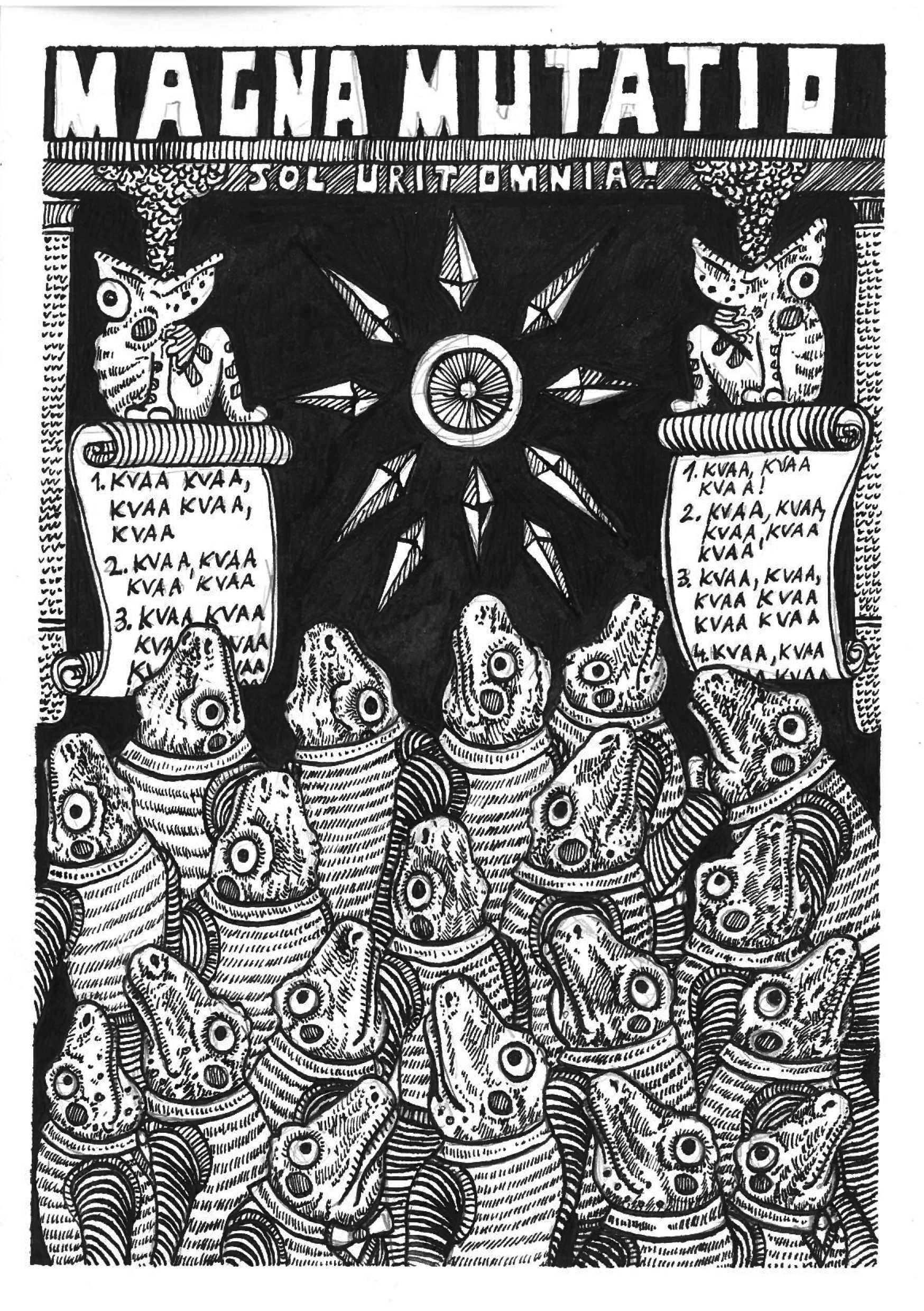
This began an artistic, eco-performative investigation of the relationships of the human and its surrounding environment. I have made drawings, ceramics, lino prints and photographs. Through making I worked the impression and the memory. I did not know how to frog, thus I sought to engage with the problem of the body. The ways of inhabiting the ecosystem are inherently different between the human and the frog. I think of three bodies in order to tackle the issue. The HUMAN as the FIRST body. The FROG or the OTHER as the SECOND body. And THE WORK ITSELF as the THIRD body and thus itself a collective environment of objects and actions in its own right.
Through constant doing, constant making I seek to create a link and a searching to story the world, to inhabit the inhabited with my characters that I make. It became a “performative investigation of tensions between body, ancestry, and environment.”1 “The Fabric of Life -learning to frog anew” is a way for me as a young architect to architect the world, a means to deal (do away?) with present hierarchies. Because of this the body of works becomes “An Architecture (or better, an “archi-texture,” that is to say a weaving or interviewing of places that manages to connect worlds that at first do not meet each other)”.2
Although I am no expert in the field of nature conservation, I have identified key issues on how the human-altered world, techno-nature affects amphibians (creation of borders, invasive species, incapacitation of sight, fungal infections). I have made tools for frogging. I made drawings. I created an environment to frog. I have submerged the human into the creek of the Fabric of Life! A seeking of absolute frogstasy occurs! THE WORK and the Fabric of Life allows for an eco-performance to occur that can ”among other possibilities, question, honor and reaffirm human being/environment interconnections.”3
“Fabric of Life - learning to frog anew” is an ongoing daily practice of making. It is an attempt at a performative act that puts me in the service to the Fabric of Life and the environment. I have produced several series of works that brought me closer to my object of fascination. It allowed me to glimpse at and get closer to the animal. The working of the subject, the keeping with the trouble allowed me to eco-perform and create an architecture of understanding and of caring.


- Maura Baiochi, 2009 – retrieved from https://www.ecoperformance.art.br/about-ecoperformance
- Álvarez de Toledo, S., Boccon-Gibod, T. and Ogilvie, B. (2013) Cartes et lignes d’erre: traces du réseau de Fernand Deligny, 1969-1979. Paris: l’Arachnéen.
- Maura Baiochi, 2009 – retrieved from https://www.ecoperformance.art.br/about-ecoperformance
Contact

Vilius Jokubaitis / +37061442421 / jokvilius@gmail.com