Watch the lecture online
Read the full thesis
Programme
- 11:00 – Presentation of the trial lecture - "Sound is both a physical and a cultural phenomenon. Recent scholarship in architectural and related fields has increasingly explored the relationship between acoustics and the production of space, stretching from the early modern period to the digital era. The candidate is asked to engage with this expanding body of literature by examining specific moments and cases in which sound participates in the construction of built artifacts and cultural practices that shape distinct listening cultures. Maintaining the focus on the built environment, the lecture should move beyond technologically deterministic accounts of acoustic science to instead address the intertwined realms of acoustic aesthetics, politics, experimental psychology, and the formation of subjectivity. Rather than offer a general overview of the field, the committee encourages the candidate to develop a focused argument through the close analysis of selected historical cases."
- 13:00 – Public defence
Abstract:
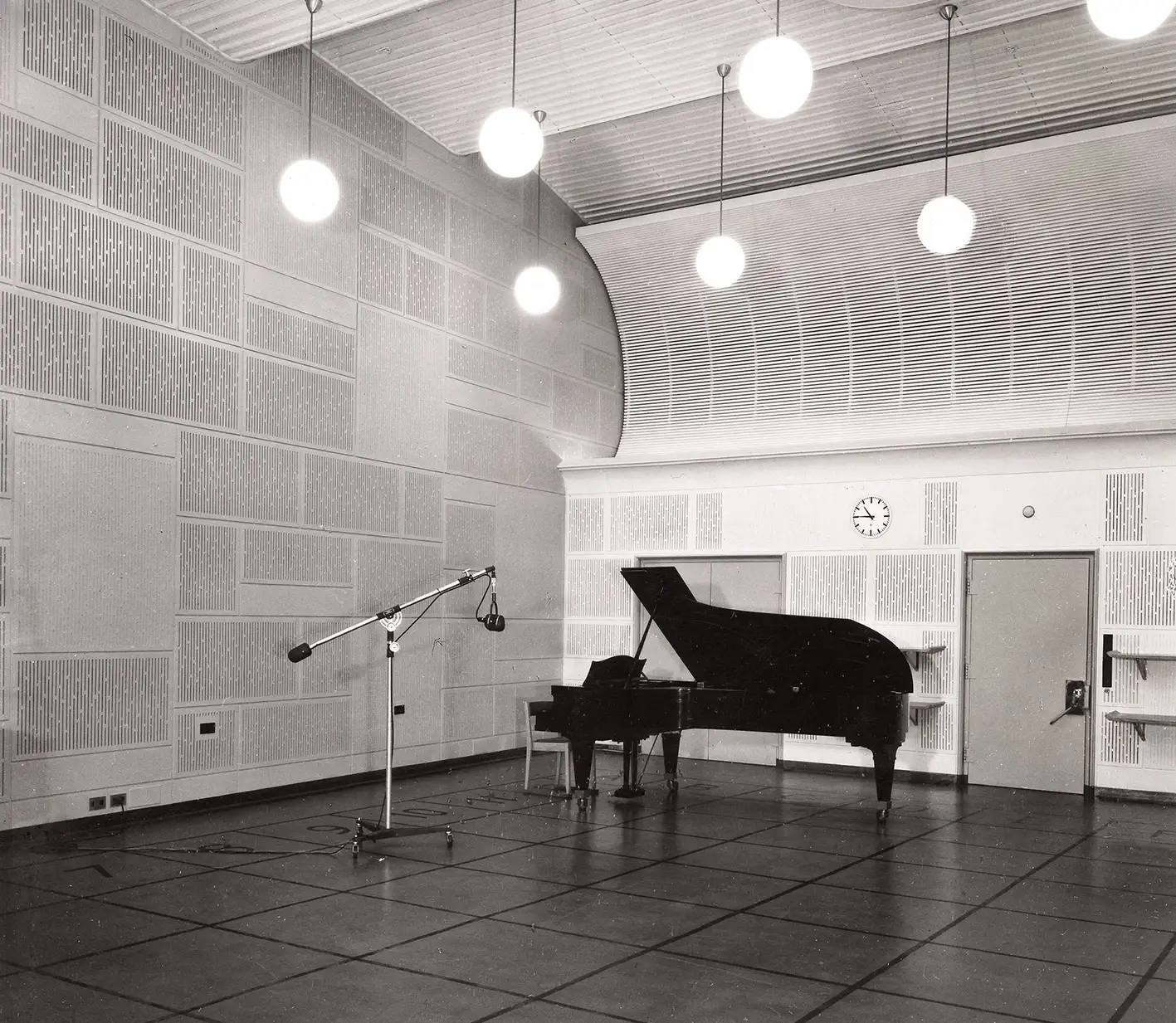
In 2020, the Norwegian public broadcaster NRK sold its properties at Marienlyst in Oslo to developer Ferd for 3.75 bill NOK. The transaction will transform the bespoke headquarters of a Norwegian nation-building institution into a private development project. Kringkastingshuset was designed by architects Nils Holter (1899–1995) and Ole Øvergaard (1893–1972), after a 1935 competition won by Holter. Radio buildings were at the time a completely new and radical building typology, and given the novelty of broadcasting technology, the architects’ task was really to plan for the unforeseen demands of a new media and its spatial requirements. A work of modernist monumentality, the broadcasting building was designed to facilitate for expansion and re-organization. Holter's practice, later inherited by younger partners, would continue working with NRK for nearly nine decades.
Based on previously unexplored archival material, the dissertation traces the genesis of Norway’s first purpose-built broadcasting building from the early committee-based planning and the competition, through its construction during the German occupation in WWII, until its publication in the Norwegian journal of architecture Byggekunst in 1951. Authorship becomes an important feature in understanding the making of NRK: including the collaborations with Norwegian scientists within the new field of acoustic science, and the architects and clients’ extensive travels to study radio buildings across Europe. With the constantly evolving nature of its programme and purpose, the building’s inherent incompleteness is directly linked to its robust longevity, prompting Holter’s method as reminiscent of ideas such as the opera aperta or open work: planned towards contingency and a multiplicity of potential meanings.
Architecture, Resonance and Reverberation. Broadcasting NRK discusses one of the most radical building typologies of 20th century architecture at the moment when it has been declared obsolete, and critically considers its material provenance, historiography and reception history.
Biography:
Jørgen Johan Tandberg is an architect and associate professor at the Oslo School of Architecture and Design, where he is currently teaching the MA studio series Architecture and the Archives.He received his diploma with honours from the Architectural Association in London in 2010 and subsequently undertook postgraduate studies at the Berlage Institute. His architecture practice has been awarded in numerous competitions, and his work published widely. He is the founder of Arkitektfaglig Presse, an independent publisher specialized in architecture.
Supervisors:
- Professor Mari Lending
- Professor Thomas McQuillan (co supervisor)
Adjudication committee:
- 1. opponent: Professor Despina Stratigakos, University of Buffalo
- 2. opponent: Professor Alfredo Thiermann, École Polytechnique Fédérale de Lausanne
- Koordinator: Professor Jonny Aspen, AHO