Register for the disputation
To participate in the disputation, you must register. You will then receive a link to the disputation, and any changes to the program will be sent to your email.
Trial lecture
The title of the trial lecture is “Methodological choices and research design when studying public spaces.”
Programme
- Welcome by the Master of Ceremony (Jonny Aspen, Professor at Institute of Urbanism and Landscape Architecture, AHO)
- The candidate presents the thesis
- Opposition from the first opponent.
- 30 minute break
- Opposition from the second opponent.
- 15 minute break
- The master of ceremony asks the committee coordinator to read the results.
- Disputation ends around 14.30
Thesis abstract
The thesis is available through AHOs digital repository
For over twenty years, open space planning in Oslo, Norway, has been driven by the vision of creating a greener, more equitable city. However, greening remains a contested term in urban design, planning and landscape research. Without an understanding of the nuances of how public open spaces are used, designers risk applying universalised assumptions about everyday use to suburban greening projects.
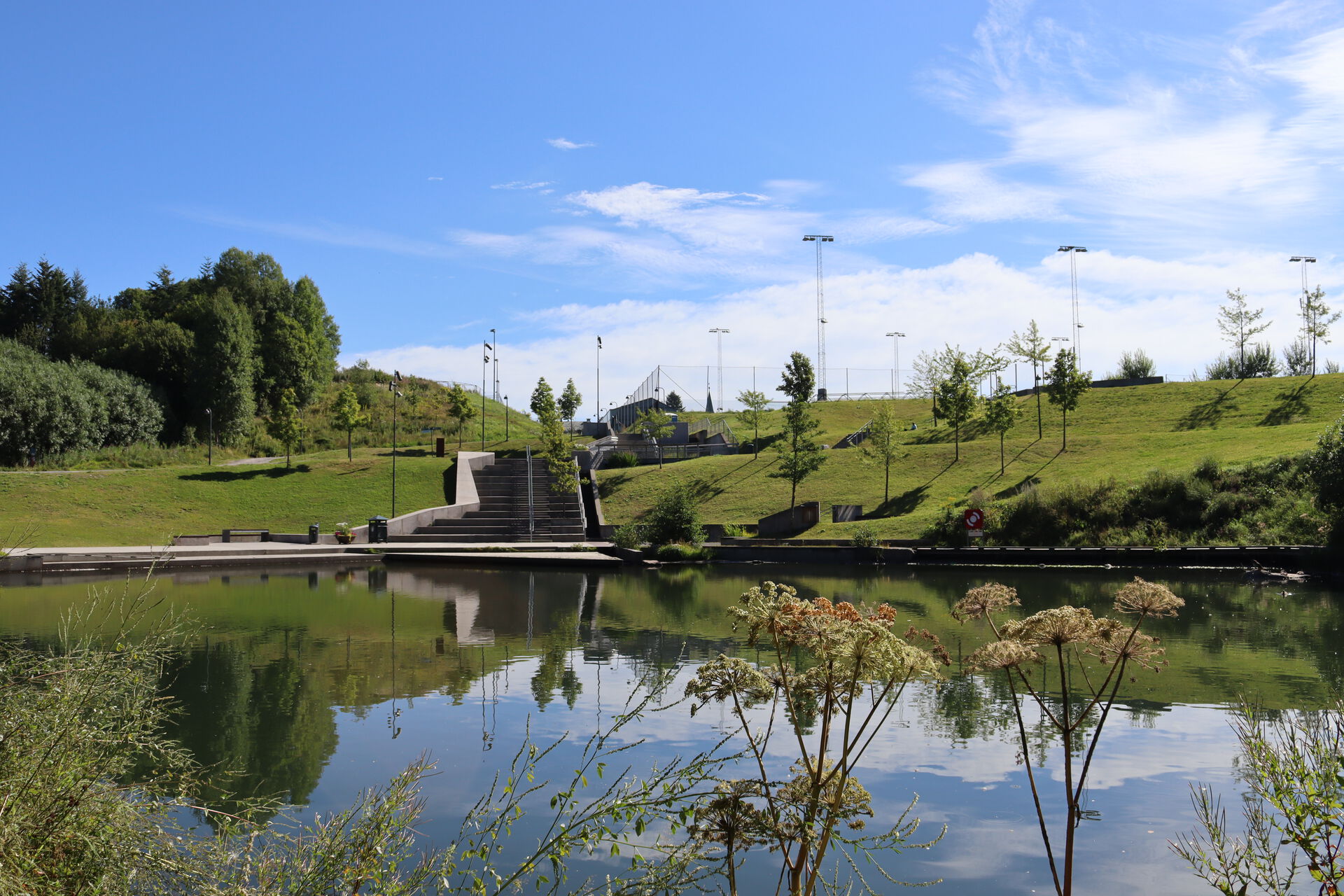
This study used the theoretical framework of critical environmental justice, encompassing distributive, procedural, and recognition justice, to examine the norms made explicit in strategic planning documents and among designers involved in daylighting projects in Oslo. Through a spatial analysis of landscape architectural drawings, walking interviews, as well as an analysis of planning documents and promotional material, this thesis first sought to understand the norms and assumptions present in the material and among designers. Secondly, in order to question and nuance these normative assumptions, direct observations of everyday use were conducted in two daylighting projects in Osloʼs Grorud Valley between April 2021 and February 2023: Grorud Park and Byggerʼn Activity Park. The everyday use of suburban parks was approached through the theoretical concept of affordances, rooted in environmental psychology, which highlights the often unseen interactions in open spaces between people and the environments they inhabit. Examining the two case studies through the lens of recognition justice and affordance theory revealed a dissonance between the terminology used by designers and in strategic policy documents, and how these open spaces were actually used.
Drawing on affordances theory, this thesis introduces four relational terms—touch, leave, merge and diverge—to provide an awareness of the dynamic moments of ebb and flow, nearing and distancing between users in these two parks in low–density neighbourhoods on the urban periphery. When the environment invites proximity and distance, as well as encounter and avoidance, users of public open spaces can interact with each other in ways that help them to manage their differences—what I call an environment of unforced coexistence.
Biography
Angela Kivle is an urban designer who graduated with a Master of Architecture with Distinction (2008) and a Bachelor of Environmental Design, both from the University of Western Australia. She has worked as an urban designer in Australia and the UK, led a graphics and planning team at OSP Architecture, and presented at events such as Oslo Urban Week and Urban Transitions (2022). More recently, she provided urban design consulting on a public art proposal for the 22 July Memorial in Oslo.
Supervisors
- Professor Peter Hemmersam, AHO
- Professor Sabine Müller, AHO
Co-supervisor:
- Associate Professor Ingrid Halland, Aarhus University, University of Bergen
First opponent:
- Professor Ole B. Jensen, Aalborg University
Second opponent:
- Associate Professor Jennifer S. Mack, KTH Royal Institute of Technology
Coordinator:
- Professor Andrew David Morrison, AHO