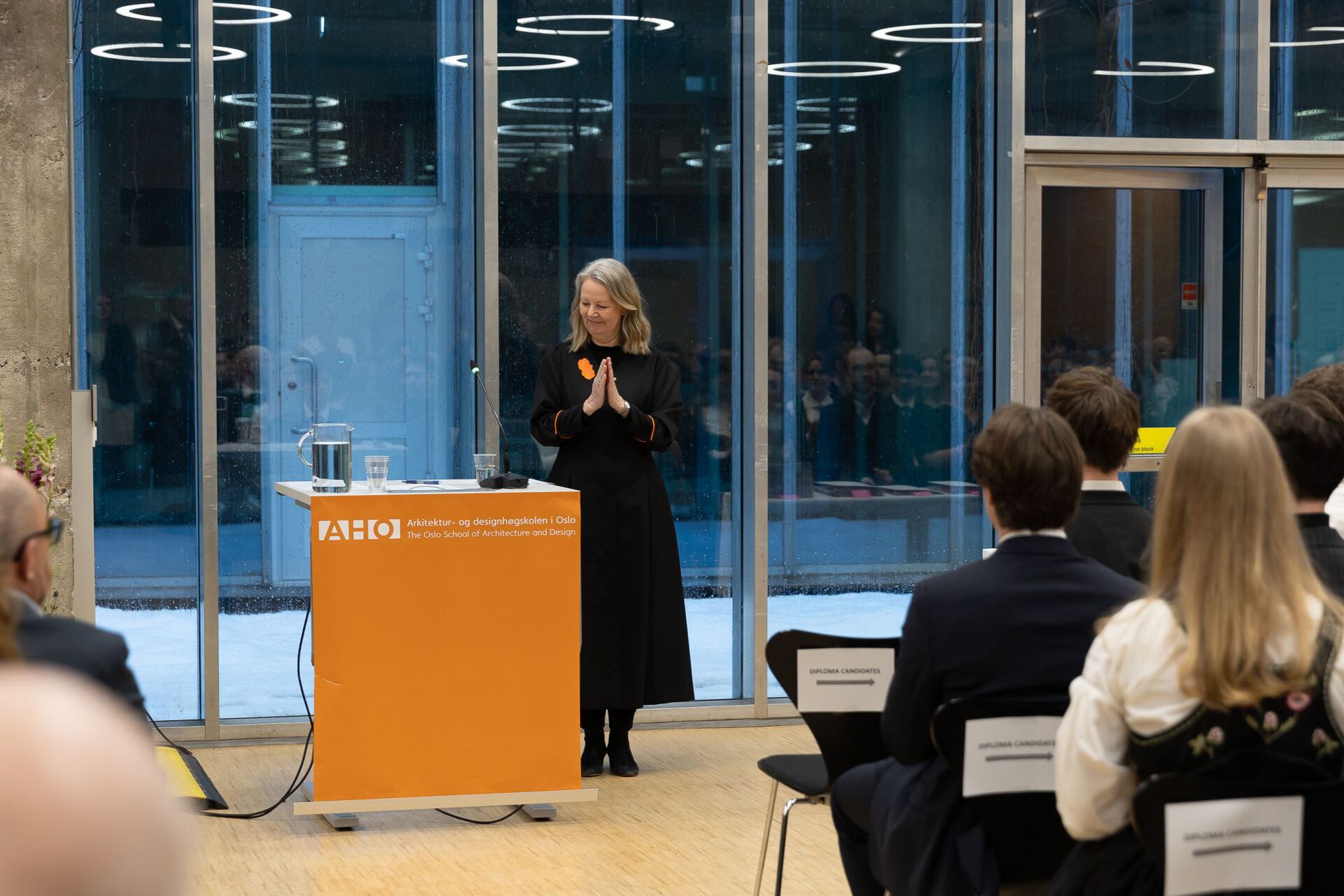
SOCIETAL IMPACT: It is a great pleasure and a great responsibility to stand here today and send you on your way. You are no longer students at AHO. You are architects, designers, and landscape architects. Our colleagues.
But how does one deliver a graduation speech at a time like this? How do we send people out into the world with confidence when the world itself does not seem particularly welcoming?
We live in a time in which power and technology are more tightly intertwined than ever before. Decisions are made faster, farther away, and often without a human face. Efficiency, optimisation, and control are highly valued—and humanity is easily pushed to the margins.
The Hour of the Predators
During the Christmas holidays, I read The Hour of the Predators by the Italian author Giuliano da Empoli. The book describes precisely this movement: a time in which aggression, boundlessness, and ruthlessness are rewarded; where empathy appears as weakness; and where taking the time to understand consequences, human consequences, can seem almost old-fashioned.
It is an uncomfortable book. And that is the point.
Because it raises a question we must take seriously: what happens to humanity when power and technology move faster than our ethical reflections can keep pace?
That question is not abstract. It is concrete. It is spatial. It is physical.
The camera sees everything
I was recently reminded of this in an exhibition at the Louisiana Museum of Modern Art in Copenhagen, featuring works by the Canadian artist Jon Rafman.
The exhibition consists of endless rows of photographs taken by Google Maps cars as they travel through the world, images captured automatically and systematically, without intention, without a gaze.
The camera sees everything: people falling, people in distress, strange situations, private moments. And beneath the images appears the dry instruction: “Report a concern.”
Report a concern.
But to whom?
And on whose behalf?
No one is watching. No one is feeling. There is only a system that records.
The exhibition offers a precise image of something we see in many places today: technologies that observe the world without being part of it; systems that organise life without having a life of their own; decisions that shape people’s everyday lives without people truly being present in those decisions.
And that is precisely why your disciplines are so crucial.
Connecting the technical with the human
Architecture, design, and landscape architecture are not neutral disciplines. They are profoundly human. They concern bodies in space, movement, pause, and community. They are about who feels at home and who does not; who is seen and who is overlooked.
You work with friction. With materials that resist. With places that cannot be optimised without consequences. You are trained to ask the question: what does this mean for those who will live with it?
You are not entering a world that is easy to shape. You are entering a world marked by crisis, climate, nature, housing, trust, democracy. But you are entering it with something the world urgently needs: the ability to connect the technical with the human, the structural with the sensorial, the large-scale with the intimate.
The world needs your way of seeing
During a visit to AHO and the master exhibition earlier this week, the Minister of Higher Education and Research, Sigrun Aasland stated:.
“The work of the master students demonstrates strong engagement, professional depth, and a clear commitment to using architecture, design, and landscape architecture to understand and shape the world we live in.”
And when the Prime Minister visited AHO last summer, he said that “Norway needs the competencies you possess.” That is true.
But I would add this: the world needs your way of seeing.
You have been educated not to accept that humanity disappears in the name of efficiency; not to allow space to be reduced to function alone; and to insist that there is always someone who must live in, with, and around what we create.
That responsibility is not an easy one. It will require you to speak up, to ask uncomfortable questions, and at times to insist when others would rather move on.
But it is also a privilege.
Yes it is also a privilege!
Building, drawing, and designing for people
Because your disciplines can do something truly special. You can give form to care, dignity, slowness, and community. You can create spaces where people are not merely data points, but participants in their own lives.
In a time that Giuliano da Empoli describes as the age of the predators, this is, in itself, an act of resistance.
I hope you will take on that task, not as heroes, not as those who have all the answers, but as professionals who know that the world becomes better when it is shaped with people in mind.
I hope you will preserve your curiosity, your doubt, and your sensitivity to what does not fit neatly into established frameworks.
And I hope you will return, as collaborators, as critics, and as those who help nurture future generations.
Dear graduates:
Congratulations. We are proud of you.
And the world needs you precisely because you build, draw, and design for people.