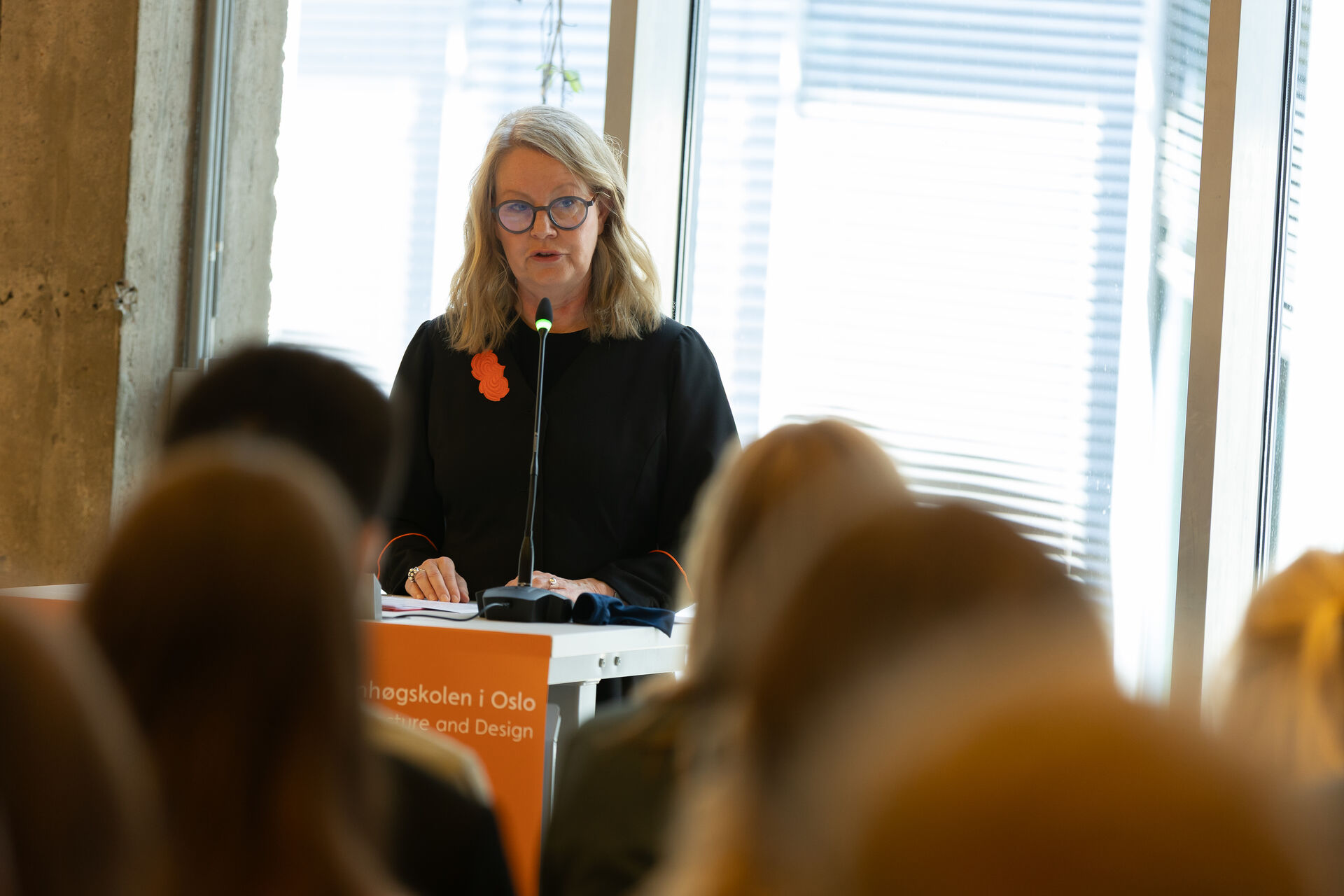
SOCIETAL IMPACT: It is a great honor and joy to stand here today—on this important and festive day—and send you out into the world as architects, designers, and landscape architects. You are no longer students here at AHO. You are our colleagues.
But how do you properly send someone off into a world like this? How do you give a speech about the future in a time when the future feels like the most uncertain thing we have?
How do you celebrate a transition—from student life to working life—at a time when work, society, and the world around us are in the midst of so many simultaneous and interconnected crises?
That's a question I've asked myself many times while preparing this speech. Because we are surrounded by signs that something is faltering. The climate and nature crisis. War and increased instability in the world and also here in Europe. Economic and social inequality. Democratic institutions under pressure.
And a view of youth that too often reduces people to performance and burden.
Shaping solutions
And yet—here you are. Ready to contribute. Ready to create. Ready to take responsibility.
And perhaps that's the most important thing to say today: Your professions—what you have learned and developed during your years here—are not just relevant. They are necessary. You hold keys to some of the very questions posed by these crises.
During a visit by Norway’s Prime Minister Jonas Gahr Støre earlier this week, Støre said at an open debate with AHO students: “What you are doing here is fundamental.”
Støre’s visit was an important recognition of the role that architecture and design play in societal development – and not least of the professional expertise you are being educated in.
For it is precisely here, in the intersection of aesthetics, technology, and ethics, that the solutions to many of our greatest challenges are being shaped.
We also talked about AHO’s history – our 80th anniversary – and the fact that AHO was born out of necessity and crisis – after World War II and as part of the rebuilding of Norway.
We live in a world shaped by friction
Kristian Cedervall Lauta is a professor of law who researches catastrophes and risks puts it like this:
“We’ve built our societies around frictionlessness. Everything has to be easy. Efficient. Convenient. But maybe, for the first time in human history, we need to reconsider whether that’s actually right.”
He points to something crucial: Friction is not just inconvenient. It is meaningful. It is when we meet resistance that we learn. That we have to think differently. That we must act with care.
And that’s exactly what your professional fields train you to do.
To create under conditions. To think in wholes. To shape the world—not as an escape from its problems, but as a response to them.
When you leave here, you don’t walk into a frictionless world. But you walk out with tools to navigate complexity. To produce meaning in chaos. To think through materials, space, people, ecosystems, and society.
To demand the infinite
Another of Lauta’s concepts I carry with me is the idea of “demanding the infinite.” It sounds like a paradox in a time marked by limits, by crises, by budgets and climate targets.
But what does it really mean? It means that we—as a society, as an educational institution, as colleagues—should not lower the bar. On the contrary, we must dare to believe in each other. Challenge each other. Set high expectations—yes—but with care and trust.
It reminds me of a study from Stanford University: When students received criticism that began with, “I’m giving you this feedback because I believe you can use it to get better,” those students improved significantly more than their peers. Not only because the feedback was given with an expectation that the student could grow and improve, but also because it was given with care for the individual: I care about you. I trust you. I believe in you.
That’s also how we here at AHO think about education. And that’s how we should think about society. Criticism and friction as acts of trustful investment in each other's potential.
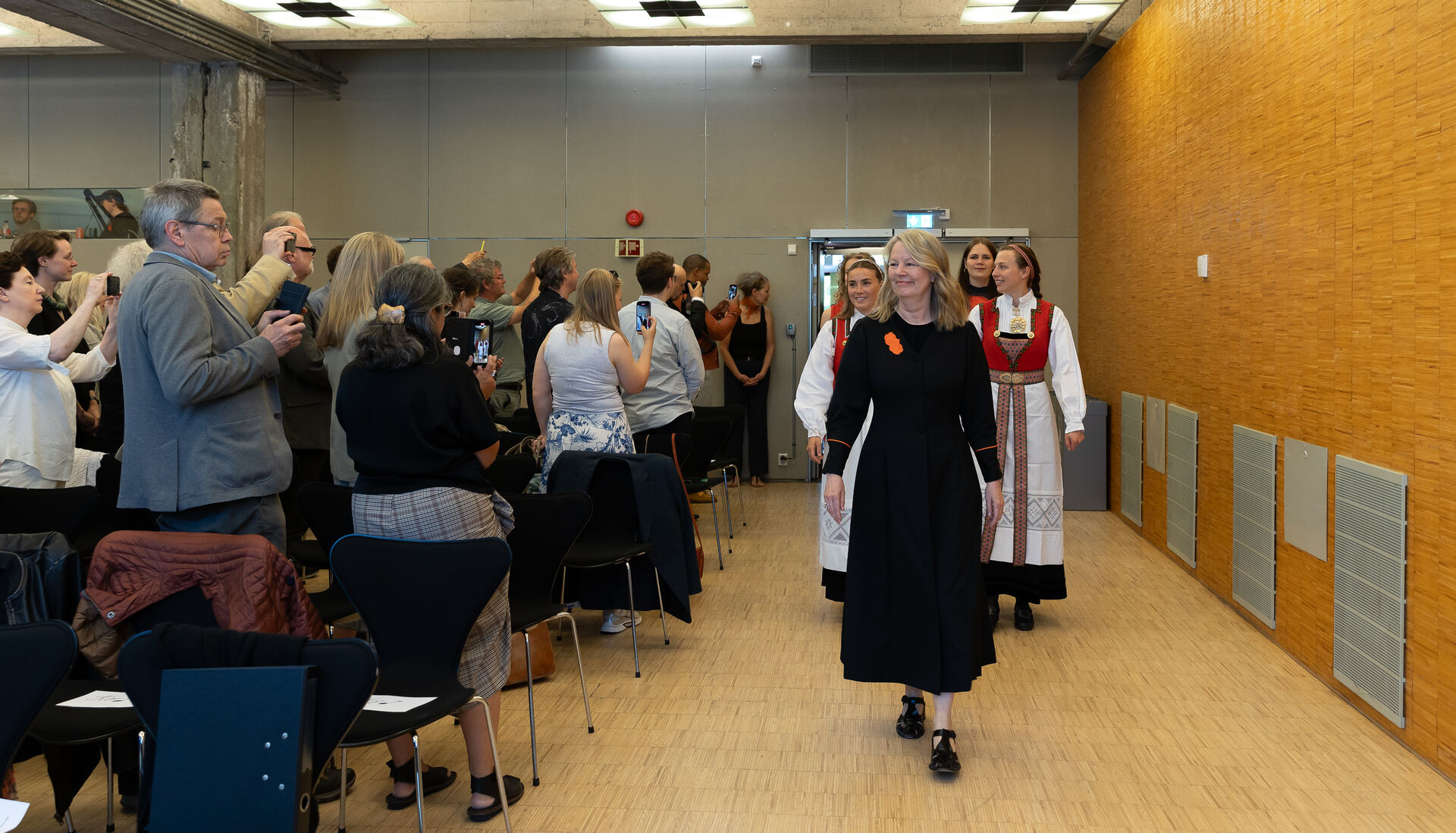
Hope as action
And that brings me to the most important point: Hope.
Not the naïve kind. Not the frictionless, Instagram-friendly kind. But the hope that is grounded in knowledge, in professionalism, and in the ability to act.
Your graduation projects testify to that hope. You’ve worked with transformation, with reuse, with new ways of building, designing, and thinking about landscapes, cities, buildings and places.
You have explored how technology and people can interact more effectively—how products, processes, and digital solutions can create meaningful experiences for individuals, and how we can contribute to building a better and more sustainable future.
You’ve explored the relationship between the physical and the social, between body and city, between climate impact and human well-being.
You have not turned away from the crises. You have turned toward them. And responded with ideas. With materiality. With structure. With poetry. With artistic ideas.
That is exactly what gives me—and us—hope. Because your professions are not just reflections of the world as it is. They are contributions to how the world could be.
Your role in society
Architecture, design, and landscape architecture are not only about aesthetics, function, and form. They are about community, about shaping life, about making the possible visible—and the invisible possible.
- It is you who will design the spaces where we live, learn, and heal.
- It is you who will rethink how we produce and consume, how we move, and how we build.
- It is you who will ask the questions the rest of us haven’t yet dared to ask—and at times, even formulate the answers yourselves.
And it is you who will transform society from within—by taking your profession seriously and letting it speak in many arenas: in building projects, in municipalities, in activism, in research, in politics, in art.
A call to action
So: Dear graduates. Your time as students ends today, but your journey is only just beginning. You step out into a world that needs you—not despite the crises, but because of them.
You become part of the larger conversation about how we are to live together in the future. And I hope you’ll take part in that—with boldness, with trust, and with your strong, creative, and analytical professional identities.
I hope you’ll ask questions we haven’t yet thought of.
I hope you’ll challenge the familiar—not just for the sake of change, but because it is necessary.
And I hope you’ll come back. As collaborators. As researchers. As teachers. As those who demand the infinite of the next generations.
Dear graduates: Congratulations! We are proud of you. We look at you with expectation—because we know you can. Thank you for choosing AHO.
And thank you for giving us hope—in a world shaped by crisis.
Reference:
Lønne, Irene Alma (2025): Graduation Speech – The Oslo School of Architecture and Design - Summer 2025.